Cats are clever, quick, and surprisingly good at slipping through open doors. A good cat door escape barrier helps you stop those dash-outs while keeping your home easy to use.
In this roundup, we focused on practical options for different spaces, from pressure-mounted gates to reinforced screen doors and wireless barriers.
Best 10 Cat Door Escape Barrier Picks for 2026
Mesh Screen Barrier
QWR Reinforced Cat Screen Door

- Reinforced mesh resists claws and climbing
- Zipper closure for easy room access
- Tool-free hook-and-loop installation
Best For: Airy doorway separation with cat resistance
Wireless Boundary System

- Adjustable radius from 0.7 to 7 ft
- Rechargeable collar and transmitter
- Designed for indoor area avoidance
Best For: Training pets away from specific rooms or objects
Wide Screen Barrier

- Fits door openings up to 36" x 81"
- Reinforced mesh helps resist claws
- Double zipper and strong tape closure
Best For: Wider doorways needing breathable cat containment
Extra-Wide Indoor Gate with Cat Door
Carlson 29.5–36.5” Extra Wide Dog Gate

- Pressure-mounted metal gate for doorways and stairs
- Patented small pet door lets cats pass through
- Walk-through opening with safety latch
Best For: Indoor homes needing a wide gate with a cat pass-through
Adjustable Multi-Pet Gate
Pet Gate with Adjustable Cat Door

- Fits 31–46 inch openings with pressure mount
- 3-level cat door for cats and small pets
- Auto-close walk-through door for daily access
Best For: Multi-pet homes needing a wider indoor gate with cat access
Extra-Tall Pressure Gate
Adjustable Cat Gate for Doorways
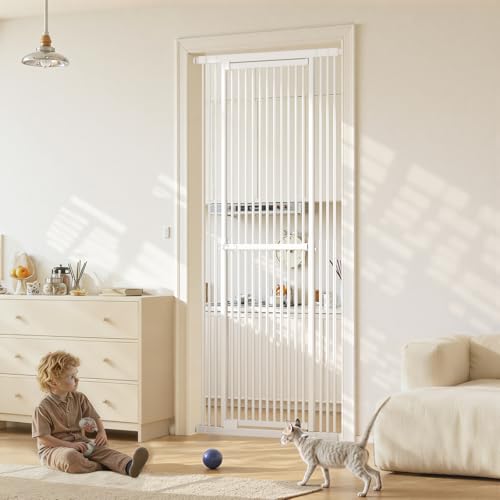
- Height adjusts from 51 to 87 inches
- Pressure-mounted installation needs no tools
- Steel frame with one-handed dual-action release
Best For: tall doorway or stair containment with a rigid gate
Tall Doorway Gate – Extra Tall Cat Gate for Doorway
If you need a cat door escape barrier that relies on height rather than electronics or mesh, this extra-tall pressure-mount gate is built to block agile jumpers at doorways, stairs, and room openings. The no-drill setup makes it especially practical for renters or anyone who wants a removable pet barrier without damaging walls.
Best For: Homes that need a tall, pressure-mounted barrier for cats and small dogs in doorways or stair openings.
Pros:
- Extra-tall design ranges from 74.8″ to 90.5″ for stronger containment.
- Pressure mount installation requires no wall drilling.
- Double lock design and narrow 1.34″ gaps help prevent slipping through.
- Two-way opening and auto-close add everyday convenience.
Cons:
- Width range is limited to 30.3″-38.2″ before extensions are considered.
- Heavier metal construction may be less discreet than a screen-style option.
For a physical barrier that focuses on height, fit flexibility, and simple installation, this gate is a strong option. It is a practical pick when your main goal is stopping escapes without permanent hardware.
Mesh Screen Barrier – QWR Reinforced Cat Screen Door
This cat door escape barrier is a good fit if you want airflow and visibility while keeping cats from pushing through an opening. The reinforced mesh and zipper closure make it useful for everyday room separation, especially where a full gate would feel too closed-off.
Best For: Doorways where you want ventilation and a cat-resistant screen barrier with zipper access.
Pros:
- Thickened vinyl-coated steel wire mesh is designed to resist claws and climbing.
- Double zipper closure makes it easy to open and close.
- Hook-and-loop strips are meant for tool-free installation.
- Keeps air circulating while helping block cat exits.
Cons:
- Only fits door openings up to 32″ x 80″.
- Requires careful measuring because the door frame is not included.
If you want a lighter visual footprint than a gate, this screen-door style barrier is a practical middle ground. It is best when your priority is separating spaces without sealing off the room.
Wireless Boundary System – FLYSPEAR Wireless Cat Barrier
For a cat door escape barrier that does not use a physical gate, this wireless indoor system uses a collar and adjustable boundary range to keep pets out of selected spaces. It is better suited to training and targeted exclusion than to physically blocking an opening.
Best For: Training cats or small dogs to avoid specific indoor areas like kitchens, counters, or stair zones.
Pros:
- Wireless design can be moved between rooms and placed in different ways with the included hook.
- 6 adjustable barrier radius settings from 0.7 to 7 ft.
- Rechargeable transmitter and collar reduce battery replacement hassles.
- 0-6 adjustable static levels offer flexible correction options.
Cons:
- Requires a collar, so it is not a barrier-only solution.
- Better for behavior control than for physically blocking an open doorway.
This option works best when you need flexible indoor boundary training instead of a fixed barrier. It can help keep pets away from problem areas, but it is not the right choice if you want a visible gate or screen.
Wide Screen Barrier – Upgraded Pet Screen Door
If your goal is a cat door escape barrier that still lets air move through the room, this upgraded screen-door style option is built for larger openings up to 36″ x 81″. The reinforced mesh and double zipper layout make it a practical pick for everyday doorways where you want separation without a solid gate.
Best For: Wider door openings that need a reinforced screen barrier with easy zipper access.
Pros:
- Reinforced vinyl-coated steel wire mesh is designed to resist cat claws and climbing.
- Double zipper inside and outside makes access more convenient.
- Strong adhesive and hook-and-loop tape help keep the screen in place.
- Lets air circulate while helping keep cats in the room.
Cons:
- Requires a careful fit since it is sized for openings up to 36″ x 81″.
- Not a rigid physical gate, so it suits screen-style containment rather than hard blocking.
This is a solid choice if you want a simple, breathable barrier with more room coverage than smaller screen options. It is especially useful when the opening is wide and you still want easy daily access.
Extra-Wide Indoor Gate with Cat Door – Carlson 29.5–36.5” Extra Wide Dog Gate
If you need a practical cat door escape barrier for a doorway or stair opening, this Carlson gate gives you a wide metal barrier with a built-in small pet door. It’s designed for indoor use where you want to keep larger pets contained while still letting cats and small pets pass through.
Best For: Homes that need a pressure-mounted doorway or stair barrier with a dedicated cat pass-through.
Pros:
- Expands from 29.5–36.5 inches wide and stands 30 inches tall.
- Built-in patented small pet door for cats and small pets.
- Pressure-mounted design installs without drilling.
- Walk-through door with one-touch safety latch for daily use.
Cons:
- Does not fit every opening in the 32–34 inch range.
- Best suited to indoor doorways and bottom-of-stairs placements.
This is a straightforward option if you want a sturdy indoor barrier that separates pets without fully blocking cat movement. The metal build and lockable small-pet door make it useful in multi-pet homes that need frequent human traffic too.
Reinforced Screen Barrier – Heavy Duty Pets Proof Screen Door
For a cat door escape barrier that keeps fresh air flowing, this reinforced screen door is built to cover standard door openings while helping stop pets from running out. It uses a durable alloy-steel material and a zipper-and-magnet closure to create a lightweight indoor-outdoor barrier.
Best For: Door openings that need a screened pet barrier with ventilation and easy entry.
Pros:
- Fits door sizes up to 34 x 80 inches.
- Reinforced alloy steel material is made to resist cat scratching.
- No-tool installation with adhesive hook-and-loop strips and push pins.
- Bilateral zipper closure plus magnets for daily use.
Cons:
- Requires a clean door frame for best adhesion.
- Door frame is not included.
This is a good choice if you want a barrier that helps keep pets in without sealing off airflow or visibility. It works best when you need a screen-style solution rather than a solid gate.
Adjustable Multi-Pet Gate – Pet Gate with Adjustable Cat Door
This pressure-mounted cat door escape barrier is designed for busy indoor spaces where you need to separate pets without making daily movement difficult. Its adjustable width, built-in 3-level cat door, and auto-close walk-through panel make it a flexible fit for hallways, kitchens, doorways, and stairs.
Best For: Multi-pet homes that want a wider gate with an adjustable cat door and auto-close access.
Pros:
- Adjusts to fit 31–46 inch openings.
- 3-level cat door lets cats and small pets pass through.
- Pressure-mounted installation requires no drilling or tools.
- Auto-close walk-through door opens both directions.
Cons:
- Cat door is adjustable, but not a full pet-access opening.
- White finish may stand out in darker interiors.
It’s a strong everyday option if you want a barrier that works for both pets and people. The adjustable sizing and auto-close door make it especially useful in homes where the gate gets opened often.
Best with Extra Features – Heavy Duty Cat Screen Door
If you need a cat door escape barrier for a doorway where you still want airflow, this reinforced screen door is built for that job. It uses double zippers, strong adhesive hook-and-loop tape, and a vinyl-coated steel wire mesh to help keep pets from running out while the room stays open and ventilated.
Best For: Doorways where you want a simple, removable pet barrier that still lets fresh air through.
Pros:
- Double zippers inside and outside make opening and closing easier.
- Vinyl-coated steel wire mesh is designed to resist scratching and tearing.
- Strong adhesive and hook-and-loop tape help keep the screen in place.
- Works for door openings up to 38 x 81 inches, with the stated fit guidance.
Cons:
- Must be installed on a clean wall or frame surface for best adhesion.
- Not suitable for carpeted or debris-covered cement surfaces.
- Door frame is not included.
Overall, this is a practical option if you want a lightweight, tool-free barrier that helps stop pets from bolting through a door. It focuses on containment and airflow rather than rigid blocking, so it suits everyday indoor use.
Extra-Tall Pressure Gate – Adjustable Cat Gate for Doorways
For a cat door escape barrier that behaves more like a true gate, this extra-tall pressure-mounted model is built to contain pets in doorways and stair openings. Its adjustable height, included extension kits, and steel frame make it a stronger choice when you want a more rigid physical boundary than a mesh screen.
Best For: Homes that need a tall, pressure-mounted gate for doorways or stairs.
Pros:
- Adjusts from 51 to 87 inches high for a taller barrier.
- Width ranges from 27.56 to 37 inches with included extension kits.
- Pressure-mounted setup installs without drilling or tools.
- One-handed dual-action release adds everyday convenience.
Cons:
- Must be raised and secured to the desired height after unpacking.
- Maximum width is 37 inches unless you add extra extensions.
- Heavier steel build may be more gate-like than a quick removable screen.
This is the most gate-style option in the group, so it fits buyers who want a sturdier containment solution for doorways or stair access. If you need a taller, more rigid barrier and prefer pressure mounting, it stands out well.
Scratch-Resistant Mesh Barrier – Extra Tall Cat Screen Door
If your cat door escape barrier needs to cover a standard opening without blocking airflow, this extra-tall mesh screen is designed for that purpose. It combines rubberized mesh, widened Velcro strips, and double zippers to help keep cats out of rooms like kitchens or bedrooms while still letting air and visibility pass through.
Best For: Cat owners who want a tall mesh door barrier for standard openings.
Pros:
- Extra-tall coverage helps block jumpy cats from crossing through.
- Rubberized mesh is made for better wear resistance than standard plastic mesh.
- Widened 1.6-inch Velcro strips improve attachment to the frame.
- Double zippers on both sides make access easier when needed.
Cons:
- Fits up to 32 x 80 inches, so measurement is important.
- Requires a 34.3-inch door frame size for proper fit.
- Like other mesh barriers, it is less rigid than a true gate.
This is a solid pick if you want a tall, breathable containment screen that installs without tools. It is especially practical for households that need a room separator for cats but still want everyday visibility and fresh air.
How We Picked the Best Cat Door Escape Barrier
We looked for barrier styles that solve real escape problems: doorway gaps, screen-door access, stairway exposure, and high-traffic rooms. Priority went to products with secure mounting, tall coverage, pet-friendly entry options, and designs that fit common home layouts.
We also considered versatility, since the best Cat Door Escape Barrier is not always the tallest or most rigid option. For some homes, a reinforced screen door is the better fit; for others, a pressure-mounted gate or adjustable walk-through barrier is easier to live with.
Quick Comparison
Use the product type to narrow your choice fast. Tall pressure-mounted gates are best for standard doorways and stairs. Reinforced mesh screen doors work well when you need airflow and visibility. Wireless barriers suit situations where a physical gate is difficult to install, while models with built-in pet doors can help reduce daily hassle for multi-pet homes.
Key Buying Factors for a Cat Door Escape Barrier
Height and Coverage
Cats jump higher than many buyers expect, so height matters. Measure the full opening, including trim and nearby ledges, and choose a barrier that leaves little room for climbing or squeezing around the sides.
Installation and Mounting
Pressure-mounted models are convenient, but wall-mounted or reinforced options may be better if your cat is determined or if the barrier will be used long term. For screen doors, check mesh strength, zipper placement, and closure durability.
Access for People and Pets
If the barrier sits in a busy doorway, walk-through gates and pet-door features can save time. If you need a cleaner visual finish, a fitted screen-style Cat Door Escape Barrier may blend better into the room.
Materials and Durability
Metal gates generally offer stronger physical blocking, while reinforced mesh is lighter and better for airflow. Look for scratch resistance, stable hardware, and any design details that limit bending, tearing, or accidental gaps.
Who Should Buy Which Cat Door Escape Barrier?
Choose a tall gate if your cat bolts through open doorways or you need stair protection. Pick a reinforced screen door if you want ventilation without losing control of access. Select a wireless barrier if you need flexibility and minimal hardware. For multi-pet homes, a gate with a small pet door can be the most convenient balance of control and daily use.
In short, the right Cat Door Escape Barrier depends on where your cat escapes, how often you use the opening, and how much convenience you want to keep in the routine.